Assertion and conclusion
Every assertion gets its information and evidence type – primary or secondary, direct or indirect.
For genealogists
For you who research on commission, write local history or lead a family history society – and want to defend every conclusion.
Mimir er laget for slektsforskere som vil vise hvordan de vet det de vet. Kilden, det kilden sier, og det du konkluderer, holdes fra hverandre.
Kildene ordnes etter type: kirkebøker, folketellinger, bygdebøker, pantebøker og skifter, hver med sine henvisninger.
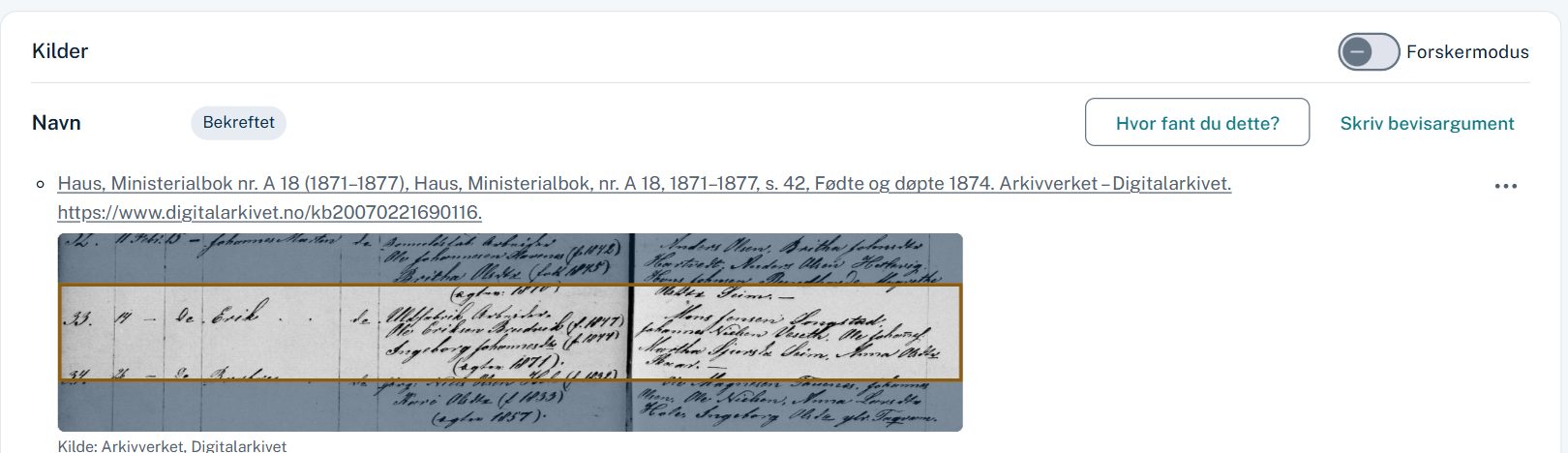
En kilde kan skrives av. Hver husstand og hver person i folketellingen blir stående slik kilden sier det, og kobles til personene i treet.
Henvisningene følger faste maler for hver kildetype. Lim inn en lenke fra Digitalarkivet, så fylles type, arkiv og dato ut, og henvisningen skrives mens du fyller inn resten.
I forskermodus står hver opplysning med det kildene sier om den: hva som støtter, og hva som motsier. Her er kildene uenige om når Johanne ble født.
Så skriver du et bevisargument: hvordan du veide kildene, og hvorfor du konkluderer som du gjør. Argumentet blir stående sammen med opplysningen og kildene.
Konfliktlisten samler alle opplysninger der kildene spriker og ingen konklusjon er skrevet, og viser hva hver kilde er verdt: førstehånds eller annenhånds.
Forskningsloggen holder rede på hvert søk, også de som ikke ga noe. Og oppgavene viser hvilke folketellinger som ennå ikke er sjekket, person for person.
Treets helse finner det som ikke kan stemme, som en folketelling før fødselen, eller en mor som var for ung, og tar deg rett til rettingen.
Mimir er i lukket beta nå. Be om en plass på mimirlineage.com.
Proof standard
Mimir keeps each source's assertions apart from your conclusion. Conflicting information stands side by side until you have reasoned it out – and the reasoning becomes part of the tree.
The status is derived from the sources and your evaluation – never stored on its own, so it can never be left wrong.
Every assertion gets its information and evidence type – primary or secondary, direct or indirect.
Parish registers, censuses, probate, mortgage registers, court records, emigration records, local histories and newspapers – each with the fields it needs.
Where you looked, what you did not find, and what comes next – per person and for the tree.
Write the reasoning behind a conclusion, with the sources it rests on – while the evidence is still being weighed, or once you have concluded.
An oral account is weighed by how the informant knows it – were they there, or did they hear it from someone?
The whole tree out at any time: GEDCOM 5.5.1 or 7, GEDZIP with the photos, or Mimir's documented lossless JSON format.
Living persons are filtered on the server, in exports and search too. Data is stored in Norway, and nothing is shared with third parties.
Closed beta, free. We let a few people in at a time – apply, and tell us what you can bring.
{free} places free right now Only {free} of {places} places left Every place is taken right now – you can still apply